
Designing Principles into Practice
How product design helped shape the Better Deal for Data
May 7, 2026 | Courtney Tiberio
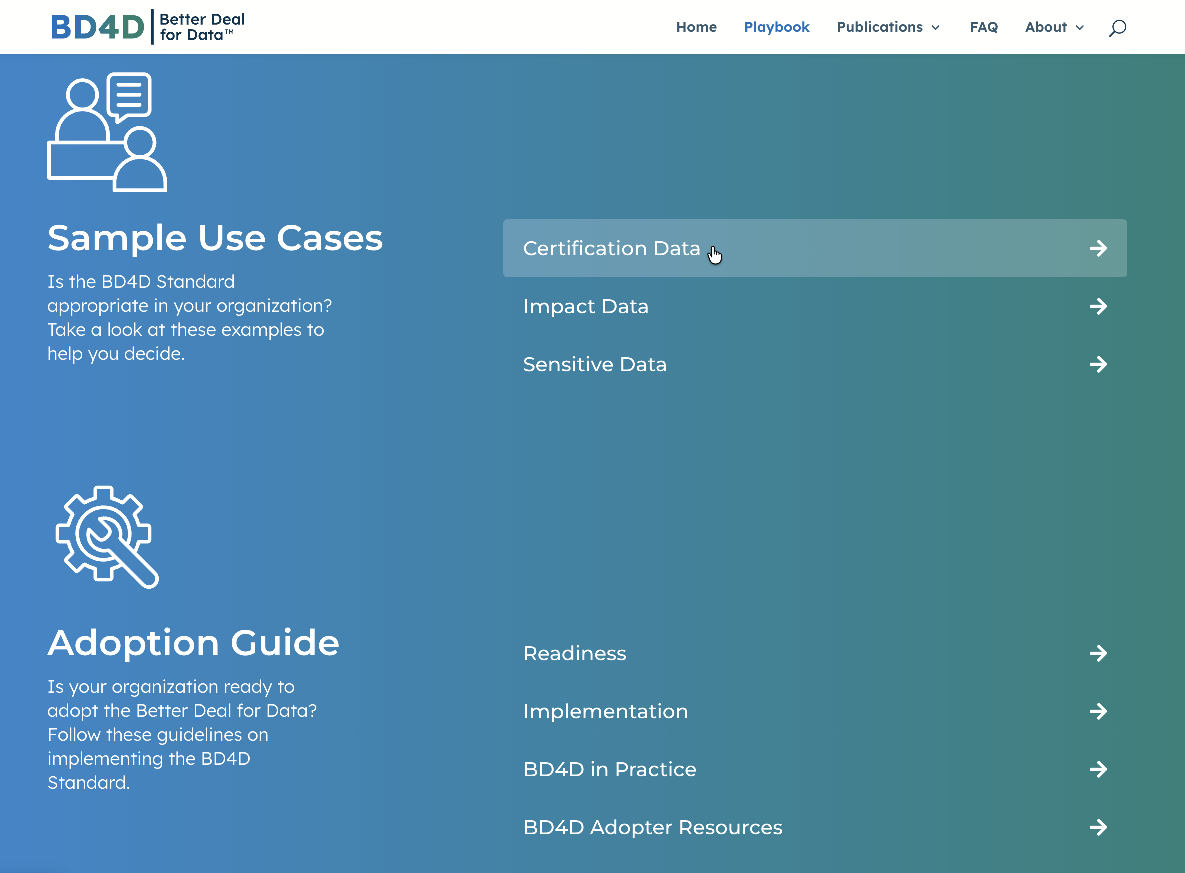
A screen shot of the BD4D Playbook Table of Contents showing the Sample Use Cases and Adoption Guide sections.
There’s a particular kind of deer-in-headlights moment that happens for a product designer joining a project that doesn’t yet know what it will become. When I first came on board with the Better Deal for Data (BD4D), I was directed to a folder of dense academic papers written by people who had been deep in the weeds of data governance. The content was rich and rigorous, the audience was varied, and the “product” was somewhere between a certification, a license, a manifesto, and a movement.
“But what is it?” was a question the team heard often, and for quite a while, we didn’t have a clean answer.
As a Senior UX Designer at the nonprofit Tech Matters—where my 20-year generalist background has a way of spilling into whatever a project needs—I’ve learned to sit with that kind of ambiguity. My work with the team was to help build their research and insights into something tangible.
Drinking from the firehose
I’ll be honest about the starting point: I did not walk in and immediately see the vision. I had a lot of learning to do. The team had spent a year on research and was steeped in the complexities of nonprofit data sharing, data colonialism, data feminism, data stewardship, and existing data ethics frameworks. I was brand new to most of it.
As fellow designers might recognize, that turned out to be a useful position.
Because I had the perspective of someone unfamiliar with the subject matter, I could see where dense concepts needed translation, where entry points were unclear, and where people like me—curious and wanting to serve the nonprofit mission, but not domain experts—would get lost. I was, in effect, a stand-in for the audience we were trying to reach.
So I leaned into it. I started exploring: How can we make this all into something approachable, understandable, and welcoming? How can we get nonprofit leaders excited about the operational reality of data governance? What might an implementation model look like? I dug into examples, sketched out structures, and started playing with how all this material could be organized.
In doing this work, the design exploration wasn’t just packaging for existing content. It became an active player in the project itself. The information architecture helped show the answer to the question “What is this thing?”
When numbers aren’t enough
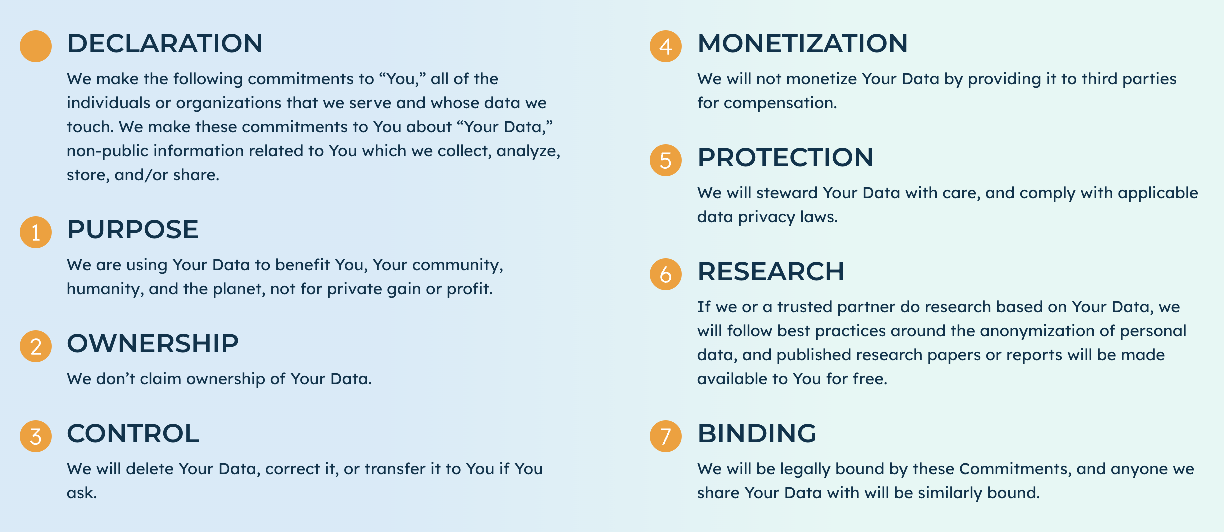
The foundation of the Better Deal for Data is a set of commitments that an organization makes to its data stakeholders. And, one of my earliest observations was that a small but significant detail introduced friction to this core content: the BD4D Commitments were being referenced by number. A sentence might read “commitment 2 addresses ownership of data…”, forcing the reader to stop, look back at what the second Commitment said, and then re-engage with the sentence. The numbered list approach made the Commitments harder to scan, and harder to recall.
In the initial proposal for the Better Deal for Data there were eight commitments; after dozens of consultations with the nonprofit community, the team refined them down to seven. In that process, what used to be “Commitment 7” was now “Commitment 6,” for example, making anything referencing a number outdated and confusing.
The fix was simple and, I think, elegant: give each commitment a name, not a number. I made the case to the team for why names mattered, and we changed them to:
- PURPOSE
- OWNERSHIP
- CONTROL
- MONETIZATION
- PROTECTION
- RESEARCH
- BINDING
This is a straightforward application of a core UX principle: recognition over recall. Users—readers, in this case—shouldn’t have to remember what a number means every time they encounter it, nor should the writer have to explain every time. A name is immediately meaningful. When the content is already dense, removing that small friction matters more than it might seem.
Now when the reader encounters “the Monetization commitment,” they immediately know what territory they’re in. The name does the work before the sentence even finishes. Scannability improves. Recall improves. And the whole framework becomes more conversational—easier to talk about, easier to remember, easier to care about.
Maturing the brand
When I inherited the project, the logo was a rainbow gradient of bright colors. The website had clean bones, but with visual elements that were a bit compensatory, filling space where content and identity hadn’t yet fully taken shape.
As BD4D matured, the brand needed to mature with it. It needed more gravity—more sense of “this is a trustworthy data standard”—without tipping into being cold or institutional. It needed to convey trust without being boring.
The palette—deep navy, forest green, a bright orange accent—is purposeful. It’s the palette of something that takes itself seriously, but hasn’t forgotten that it’s meant to invite people in. The gradient says: this is a living thing. It moves forward.

The Primary Logo page from the BD4D Brand Guide.
Turning complexity into invitation
The centerpiece of my work is the Playbook. What the team started writing was, essentially, pages and pages of text. Necessary, thorough, important text. But a lot for anyone to take in.
Implementing BD4D isn’t a quick read-and-sign checklist. It’s potentially a significant organizational undertaking involving staff across departments, existing vendor relationships, legal agreements, and a close look at data practices that may never have been formally examined. The design challenge was to make that process feel navigable rather than crushing. It needed to meet people where they are, not demand they start from the beginning.
My goal was a document that felt simultaneously scannable and deep, and offered multiple ways in. Where you can choose your own adventure and jump to the section most relevant to your role or organization right now, hand a specific section to a colleague, or follow from beginning to end if you want the full arc.
My approach started with the Table of Contents. I gave it visual hierarchy—headings, subheadings, graphical elements—and used it to establish a structural logic for the entire document. This might sound like a mundane place to begin, but structure communicates priority before a reader processes a single word. When someone opens a dense document, their eye scans for signals: What’s here? Where do I start? Is this for me? Good hierarchy answers those questions right away.
That Table of Contents became a template that the team could write to, giving them a skeleton to organize around.
After seeing my approach, Celine, who leads Better Deal for Data, put it well: “Taking complicated things and making them appear simple, approachable—taking people down through the layers of complexity so they can carve their own way through the density of material.” That was the job of the designer: not to dumb down or oversimplify, but to open a door.
When Celine showed the new brand and Playbook preview to early BD4D collaborators—the people who had been giving interviews, reviewing papers, and debating what BD4D should and shouldn’t be—she noticed audible “oohs and aahs.” This is a moment I relish, not just for the compliment it implies, but for what it represents: all this work that had been built in research and writing and debate, they were suddenly able to see the big picture, to grasp what the “product” is, and see how it would work for a wide audience and varied implementation models. Suddenly they could see the “thing”. What it was, who it was for, how it would work in the world.
When the Product Is Just Words
If you’re a designer who has ever been handed a project that felt academic, text-heavy, conceptually dense, underdefined… this one’s for you.
The design work on BD4D was consequential precisely because the project was all those things. There was minimal brand starting point, no tangible product to take screenshots of, no obvious metaphors to lean on. Just ideas—important, complicated, world-improving ideas—and the challenge of making them land.
That’s a design opportunity, not a limitation.
The structure you create can give form to something struggling to become. The names you give things change how people think and care about them. The questions you ask can turn abstract principles into a conversation that changes how an organization operates. The brand you craft can allow thinkers and writers to see what they’ve been building together.
Design isn’t just packaging. Done well, it’s part of making the thing what it is.
Defining BD4D has, at times, been uncomfortable because of its shapelessness. But, for me, leaning into that discomfort of not-knowing and wading through it one step at a time, resulted in a body of work I’m genuinely proud of, made with a small, brilliant team, for a cause worth caring about.
Great design is often invisible. It just works, and people know it unconsciously. When it lands, they don’t say “great design!”—they say “yes, of course. Of course this is how it should look.” That’s the goal. That’s when a designer knows they’ve done a good job. It’s the part of the work that brings real joy, that moment of magic, to the whole process.
Courtney Tiberio is Senior UX Designer at Tech Matters, where she works across multiple projects including Better Deal for Data, LandPKS, and Terraso Story Maps. She is a UX generalist with a background in app design, brand and graphic design, web design and development, UX research, information architecture, and content strategy. Find her at linkedin.com/in/courtney-tiberio/